Skin Clinic In Singapore Marketing Playbook
Introduction
1.1. The Singapore Dermatology Market: A Data-Driven Snapshot
The Singaporean market for skin health is split into two distinct, yet overlapping, arenas: medical dermatology and aesthetic treatments. While the aesthetic market is large and growing, the demand for accredited dermatological expertise is a powerful, trust-driven sub-sector. Your clinic operates here.
The key market differentiator is the protected title of “dermatologist.” In a sea of “aesthetic doctors,” a certified dermatologist recognized by the Specialist Accreditation Board offers a higher level of diagnostic capability and treatment authority. This is your single most potent marketing weapon.
The market is governed by the stringent Ministry of Health (MOH) advertising guidelines. This is not a hindrance; it is your strategic advantage. While aesthetic clinics are forced to use vague language, you can lean into education, diagnosis, and medical science, which are fully compliant and inherently more trustworthy. The battle is won by being the most credible source of information.
1.2. Competitor Deconstruction: NSC, TWL, Specialist Skin Clinic
An analysis of your key competitors reveals a clear strategic gap for a modern, patient-centric specialist practice.
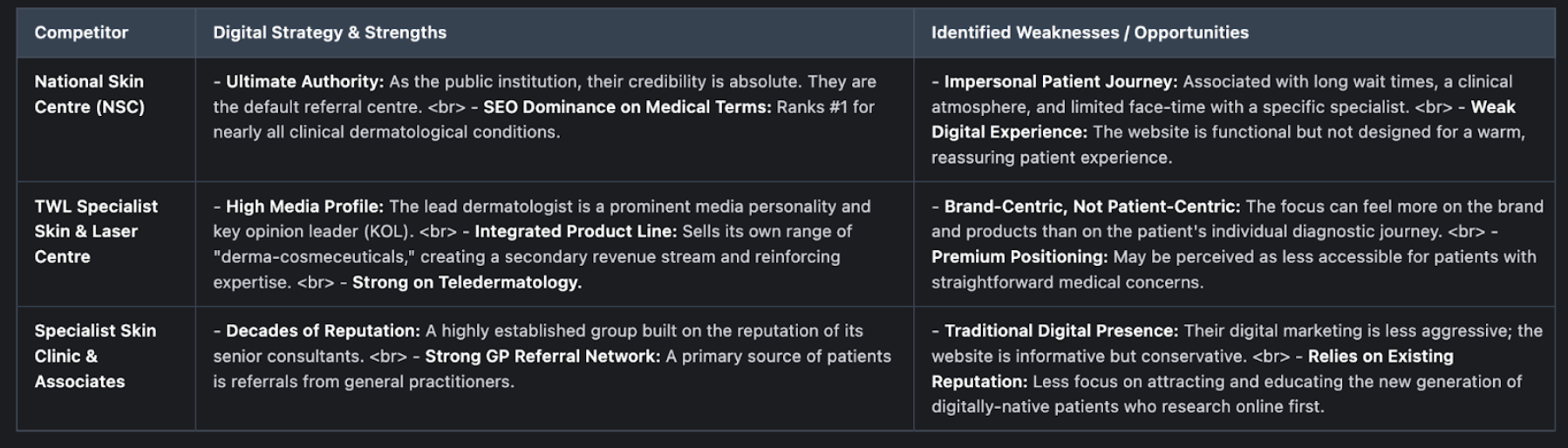
Your Strategic Opening: The NSC is trusted but impersonal. TWL is slick but brand-focused. Established clinics are reputable but digitally conservative. Your opportunity is to be the most educational and patient-centric private dermatologist. You will combine the clinical authority of the NSC with a modern, empathetic digital experience that guides the patient from confusion to clarity.
1.3. Audience Insights: The “Frustrated Patient” (Age 20-50)
Your ideal patient has a problem they can’t solve. They’ve likely tried over-the-counter products, aesthetician facials, or even consulted a GP. They are now seeking a definitive solution.
Core Pain Points & Motivations:
- Diagnostic Uncertainty: “Is this acne or rosacea? Is this spot dangerous?” They are tired of guessing and crave a definitive diagnosis.
- Failed Past Attempts: They have wasted time and money on solutions that didn’t work. They are now skeptical and value efficacy above all else.
- Information Overload & Misinformation: They are drowning in conflicting advice from social media influencers and skincare blogs. They need a single source of truth.
- Emotional Distress: A persistent skin condition affects their confidence and quality of life. They are seeking not just a clinical cure, but also emotional relief.
Your marketing must speak directly to this journey. The core message is: “Stop experimenting. Start with a proper diagnosis.”
Website Strategy
Your website must function as a pre-consultation. It should educate, build trust, and guide the patient toward seeking a professional diagnosis.
2.1. Practical Recommendations for a High-Conversion Website
- Lead with the Dermatologist: Your founder/lead dermatologist is the brand. The homepage must feature a professional photo, their full qualifications (MBBS, MMed, FAMS), and a clear “Care Philosophy” statement emphasizing a diagnostic-first approach.
- Structure by Condition, Not by Laser: This is the most critical strategic choice. Your primary navigation must be organized around the problems patients have.
- Menu: “Skin Conditions” > “Acne,” “Eczema,” “Pigmentation,” “Rosacea,” “Mole & Lesion Check.”
- The Journey: A user clicks on “Acne.” They land on a comprehensive pillar page that explains the different types of acne, the diagnostic process, and then introduces the various treatment options you offer (e.g., medical creams, oral medication, laser therapy).
- Create “Pillar Pages” for Core Conditions: Each condition page must be a 2000+ word, definitive guide. It must include:
- Clear explanation of the condition.
- Causes and triggers.
- How a dermatologist diagnoses it.
- A detailed breakdown of all evidence-based treatment options.
- An extensive FAQ section.
- An indicative consultation and treatment fee range.
- Compliant, Educational Case Studies: Replace “Before & After” galleries with “Patient Journeys.”
- Title: “A Patient’s Journey with Adult Hormonal Acne.”
- Content: Describe the initial concern, the diagnostic process (e.g., “examination revealed deep, inflammatory cysts”), the multi-pronged treatment plan created by the dermatologist, and a textual description of the outcome (“significant reduction in inflammation and prevention of new scarring over a 6-month period”).
- Transparent Fee Structure: Create a “Fees & Charges” page. Clearly list the cost of a first consultation and follow-up consultations. Provide indicative price ranges for common procedures. This transparency builds immense trust and pre-qualifies patients.
2.2. Proposed Sitemap
- /homepage
- /dermatologist-profile
- /skin-conditions/ (Parent Page)
- /acne-and-acne-scars
- /eczema-and-dermatitis
- /pigmentation-and-melasma
- /rosacea-and-redness
- /mole-screening-and-skin-cancer
- /treatments/ (Parent Page)
- /laser-treatments
- /medical-grade-peels
- /prescriptive-medication
- /patient-journeys
- /fees-and-charges
- /articles-and-insights (Blog)
- /contact-book-appointment
Search Engine Optimization (SEO) Strategy
Your goal is to become Singapore’s most authoritative online resource for medical skin conditions.
3.1. Keyword Analysis: Capturing High-Intent Searches
Commercial Intent Keywords (High Priority):
- Primary Targets: “dermatologist singapore”, “skin specialist novena”, “acne dermatologist sg”, “eczema specialist clinic singapore”.
- Long-Tail Targets: “private dermatologist cost singapore”, “best dermatologist for rosacea singapore”, “mole removal by dermatologist price”.
Informational Intent Keywords (The Core of Your Strategy):
- Problem-Focused: “what causes cystic acne on chin”, “is my rash eczema or psoriasis”, “how to treat closed comedones”.
- Ingredient/Science-Focused: “tretinoin vs adapalene”, “how does pico laser work for pigmentation”.
3.2. Strategic Content Recommendations
The dermatologist MUST be positioned as the author or final medical reviewer of all content. E-A-T (Expertise, Authoritativeness, Trustworthiness) is paramount.
- The “Dermatologist’s Desk” Blog: This is your primary authority-building platform.
- Myth vs. Fact Series: “Myth: You can ‘scrub away’ acne. Fact: A dermatologist explains why this makes it worse.”
- Ingredient Deep Dives: “A Dermatologist’s Guide to Salicylic Acid: Who Should Use It and Who Shouldn’t.”
- Condition Explainers: Write posts targeting every conceivable long-tail question about the conditions you treat.
- Video is Mandatory: Create short videos of the dermatologist explaining concepts. Embed these videos at the top of your corresponding blog posts. This significantly increases user engagement and signals authority to Google.
3.3. Backlink Strategy
- Medical & Health Media: Pitch the dermatologist for expert commentary on skin-related topics to major health portals (HealthXchange, HealthHub) and national media (The Straits Times, CNA).
- GP & Allied Health Referrals: Build relationships with General Practitioners, endocrinologists, and allergists. Create educational resources they can share with their patients (with a link back to your site).
- Answer Questions on Quora/Reddit: Have the dermatologist (or a medically-supervised assistant) provide detailed, credible answers to questions about skin conditions in relevant forums, with a simple, non-promotional link in the profile.
Paid Advertising Strategy
Your paid ads must be professional, educational, and fully MOH-compliant.
4.1. Google Ads Framework
- Campaign Structure: Segment campaigns by condition (e.g., “Acne,” “Eczema,” “Pigmentation”). This allows for highly targeted ad copy and landing pages.
- Ad Copy (MOH-Compliant):
- Lead with Expertise: “Consult a Dermatologist.”
- Focus on Diagnosis: “Get a Diagnosis for Your Skin.”
- CTA: “Book a Consultation.”
- Example Ad (for “acne treatment singapore”):
- Headline 1: Struggling with Acne?
- Headline 2: Consult an Accredited Dermatologist
- Headline 3: Evidence-Based Treatment Plans
- Description: Stop the guesswork. Our specialist skin clinic provides accurate diagnosis and effective, personalised treatment for all forms of acne. Book your consultation today.
- Landing Pages: Ads must lead to the relevant, comprehensive “Condition Pillar Page,” not the homepage.
4.2. Facebook & Instagram Ads Strategy
Use this for top-of-funnel education, not for direct conversion.
- Targeting: Target users interested in dermatology, luxury skincare, health & wellness, or who follow competitor pages. Use retargeting to reach people who have read specific articles on your blog.
- Ad Creative (Education First):
- Doctor-to-Camera Videos: A 60-second video of the dermatologist explaining “3 Reasons Your Eczema Keeps Flaring Up.” The CTA is “Learn More,” linking to the full blog post.
- Carousel “Myth vs. Fact” Posts.
- Do NOT show procedures or make any treatment claims.
Social Media Strategy
Your social channels are for establishing the dermatologist as the definitive source of truth in a noisy market.
- Platforms: Instagram for visual education and myth-busting. Facebook for sharing longer articles and building community. LinkedIn for the doctor’s professional profile and networking.
- Content Strategy: The Empathetic Expert.
- “Save Your Skin” Series: Quick tips on what not to do for common conditions.
- Ingredient Spotlight: A weekly post breaking down a common skincare ingredient.
- “Ask a Derm” Q&A: Collect questions via Instagram Stories and answer them in a weekly post or video.
- Video is Your Trust Accelerator:
- Whiteboard Explainers: The dermatologist sketches out how a condition like acne develops.
- “What’s in My Clinic?” Series: A short tour showing a specific piece of technology (e.g., a laser) and explaining the science behind it in simple terms.
Performance Measurement & KPIs
Track the metrics that lead to a full appointment book.
- Primary KPIs:
- Number of New Patient Consultation Enquiries.
- Cost Per Enquiry (CPE).
- Enquiry-to-Appointment Conversion Rate.
- Leading Indicators:
- Organic ranking for high-intent medical keywords.
- Engagement rate on doctor-led educational content.
Conclusion
The Singapore skin clinic industry presents significant opportunities for operators who strategically leverage digital marketing capabilities and emerging technologies. While the market remains competitive, substantial gaps in current digital marketing practices create immediate opportunities for differentiation.
By executing this playbook, your clinic will build a powerful, defensible brand. You will attract patients not by shouting the loudest, but by being the most trusted and authoritative voice in the room. This is how you win in the long term.
Claim your FREE 90-Day
Marketing Action Plan for
for Skin Clinic in Singapore
This is for skin clinic in Singapore looking to grow—
book a no-obligation call to get your action plan and discuss your business!